Before I cut gluten out of my life forever (it was an unhealthy relationship to begin with), I loved doing my own nail art. I could get my finger-spades (shout out to Schulten!) to grow long enough that they looked fake and strong enough that I could abuse them daily with acetone and glitter and they’d still be there for me.
They were so sparkly!
Now that I am gluten-free, though, I cannot get my nails to a decent length to save my life. Acrylic nails make me feel like I can breathe and I’m always afraid I’m going to scratch myself or, worse, poke myself in the eye. Again.
Of course, the Aspie in me perseverated (the obsessions of people on the spectrum are referred to as perseveration, as are repeated meaningless behaviors like rocking) and now I have literally hundreds of bottles of nail polish and just about every nail art tool known to humankind.
It’s true that I’d rather be able to properly digest food and get rid of the waste – 3 weeks of constipation at a time were NOT fun – than have long, pretty fingernails.
But sometimes, I feel like dealing with my “non neurotypical” (neuroatypical?) issues and my digestive function problems almost takes more tradeoffs than I should have to make.
Setting the gluten-free thing aside, let’s look at one of the biggest tradeoffs: All of this medication –
Thanks to my particular combo of comorbid conditions, I take 2 antidepressants – one for serotonin and one for dopamine. My insurance won’t cover Adderall XR, so there’s that little gem three times a day. Vitamins to make up for 30 years of nutritional insufficiency, probiotics so things move properly, and, currently Prilosec to deal with the fact that I can’t lay down without the acid climbing back up my throat.
Those last three don’t really bother me. But the prescriptions are one of my greatest internal conflicts.
Despite the fact that Beloved Spouse and Awesome Therapist have both repeatedly assured me that I am still me on the meds, I can never shake the feeling that my brain, in its natural stew of hormones, enzymes, etc. is the Real Me. Which means all this mucking about with my brain chemicals – keeping more of this, making the brain use more of that – results in the fact that my medicated state is Not Real Me.
And why do we take meds, boys and girls?
 Because our natural, unaltered brains don’t work in a way that allows us to be successful in the Real World?
That’s right!
In other words, Real World requires Not Real Me.
Chase that down the rabbit hole of depression with me and you land on the conclusion that, if Medicated Me = Not Real Me, then Beloved Spouse’s constant check-ins about whether or not I remembered to take my meds means that Beloved Spouse prefers Not Real Me to Real Me.
Intellectually, I am aware that this is, to be blunt, stupid. Not to mention destructive. When you consider that B.Spouse and I have been together for 10 years – this time around as a couple – spent part of our 20’s together, and initially met when I was a sophomore in high school, it’s actually pretty insulting to claim that B.Spouse either does not know or does not prefer Real Me.
It still bothers me. Paradoxically, it also bothers me that taking the meds doesn’t just fix the problems. Instead, the meds make it possible for me to “build new scaffolding” so that I can function, especially in the deadline-heavy, constant paperwork, documentation-reliant field of education.
In other words, now I might, possibly, perhaps, be able to build a system that means I remember to take roll every day. It’s long and frustrating and sometimes it feels like I have built and discarded enough “scaffolding” to keep Michelangelo comfortable while he paints the Sistine Chapel all over again. 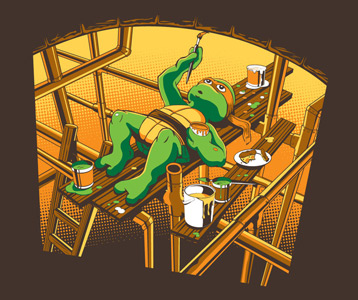
That is so Michelangelo!
Still, one wonders where the lines of “not worth it” might eventually be drawn. Psych meds have side effects – you can’t avoid them. One of mine makes me sweat so much I look like I’ve just had a shower.
Would I still be willing to swallow the pills if I suffered, not just a lower sex drive, but a complete inability to truly “enjoy” sex?
If they tell me tomorrow that the carefully selected blend of chemicals I rely on every day is likely to lead to a heart attack or debilitating stroke, would I be willing to sacrifice down the line for the benefits I’m getting now?
I guess it’s a good thing I’m not an obsessive worrier.

Of course, it could just be that I can’t remember what to worry about . . .

 I never, ever could lie. I gave it up before I ever hit puberty because I always. Get. caught.
 They expect our kids to lie. They expect them to cheat. To steal. To be disrespectful, rude, and socially backwards. Which, well, the kids will do.